Kaizen
Work a loss from PLAN to ACT, with an owner and a date on every countermeasure, and the proof it was reduced.
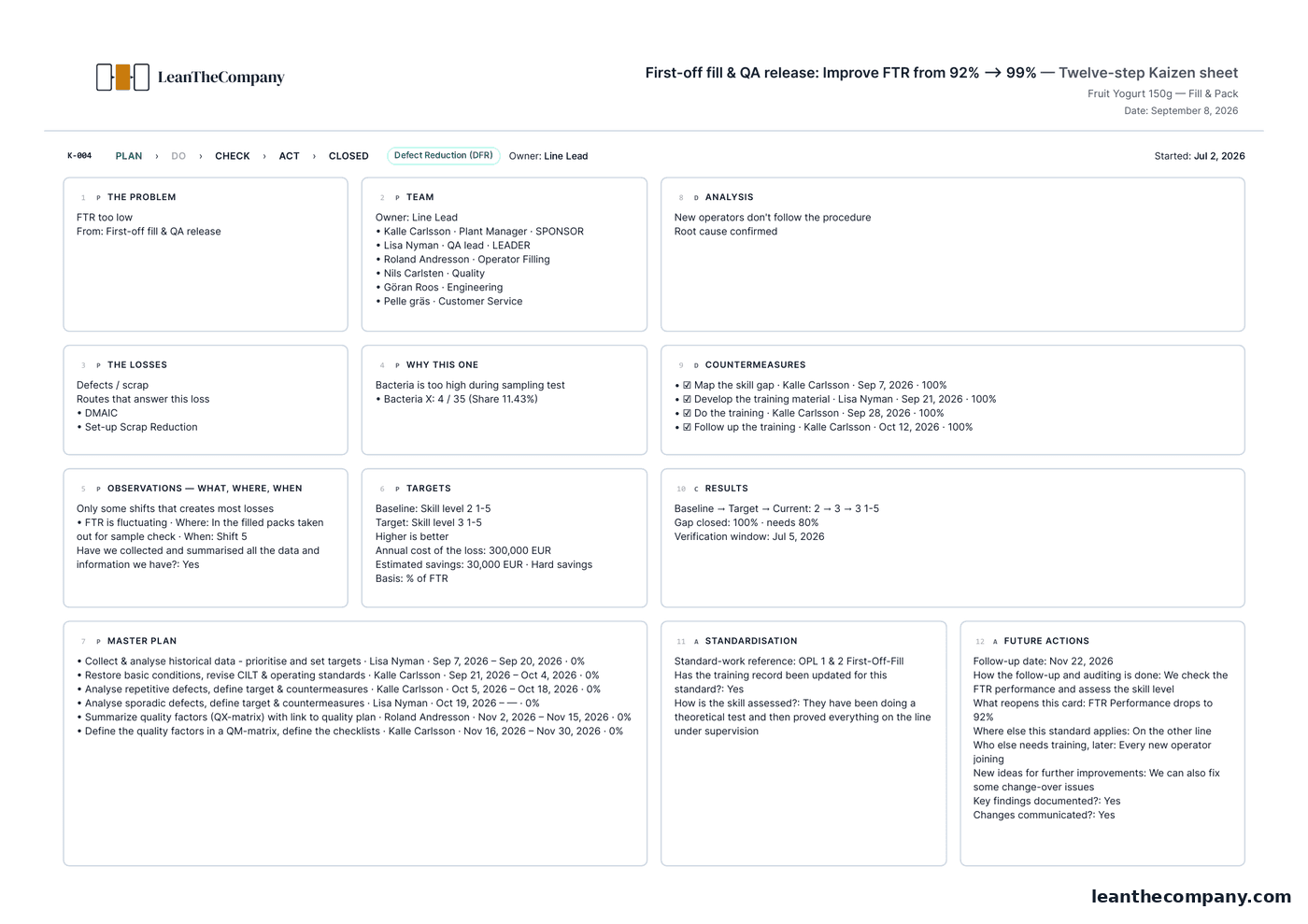
Kaizen is the only module that holds two moves, and the second is the one most improvement programmes quietly skip.
Move four is the attack. You work a loss from PLAN to ACT with an owner and a date on every countermeasure — not a workshop output, a card someone is accountable for. The maps said where; this decides what, who and when.
Move five is the part that makes the rest worth doing. Prove it stuck. A countermeasure that worked in the week it was implemented and quietly decayed afterwards is not an improvement, it is a story about one. The card carries the evidence, dated, so the claim survives contact with a shift change and an audit.
It hands its result to move six, and back to the top — a closed loss changes the numbers the next Compass and the next Bridge read.
Where it sits in the loop
Move 4 of 6
attack the loss
One Kaizen card per loss, walked one step at a time.
Move 5 of 6
prove it stuck
The Kaizen cards prove the improvement.
Chapter 8 walks through this module screen by screen.